
Is it 2026 Already ? - Gordon.

Well, it’s the end of February and I have no idea what I’ve been doing for the past two months.
Last year was a pivotal one for the business. We decided to buy, transport, and process one of the largest lots of books we’ve been offered in a decade: the large and varied library of a lifelong collector and art lover in Brisbane, about two hours’ drive north of Buderim. Looking at a lot like this is complicated. Collections of this kind are usually very mixed, and it is often difficult to gauge their value just by scanning the books on the shelves.
The library was housed in a large Queenslander and, when my mother, Fiona and I first arrived, it was crammed with antiques, art, glassware, porcelain, Staffordshire, furniture, and books. Almost every wall in the house had some sort of bookcase, some of them reaching all the way up to the extraordinarily high Queenslander ceilings. When you consider taking on a lot like this, you are really asking yourself whether the collection is worth the chaos your life will descend into over the next few years. It is important to remember that when you buy a house-load of books, you need a house’s worth of space to store them—never mind organising, sorting, pricing, cataloguing, and storing them in a way that lets you actually find them again.
These are the things I think about when I look at a house-load of books. Mum, however, tends to treat the cubic volume of our house as more of a variable than a fixed, quantifiable measurement, and seems to believe that the space contained by the walls may decide to rearrange itself if she simply wishes hard enough.
The other major part of last year was the renovation of the shop, a long overdue necessity and an attempt to reconcile the gap between how Mum wishes physical reality would behave when it comes to storing books and how it actually does. We wanted this lot, which meant we had to rearrange large parts of our life to accommodate it. The obvious problem with renovating a shop is that you are meant to take everything out, store it, and replace it with other things. In our case, that was not really feasible. I found myself learning to assemble bookshelves on the footpath and then carefully slide them into place between piles of books, or shifting just enough of a book mountain to clear a space for a sorting table in the middle of the floor. I would stare at a design on the computer and wonder, “Will this table be mother‑proof?”—meaning, if she piles it, as she is want to do, with books as high as she can reach, will it collapse?
This slightly insane method of renovation—erecting a bookcase, sorting the books for it, filling it, and thereby making just enough space for the next case—was punctuated by day‑long trips to Brisbane to sort, box, and extract this enormous lot.
When you buy a large lot of books, they are almost always a mixed bag. You get the better things you’re excited to handle, but you also get a load of dross, sometimes as much as 60% of the lot. For a bookshop like ours, it is critical to have a release valve: a way to get rid of the things we don’t want on the shelves or that simply haven’t sold. This can be very hard for people who love books. Throwing anything in the bin feels almost painful. That’s why filling the five‑dollar trolley is possibly the most important part of our day. If something has sat on the trolley for a week and no one wanted it for five dollars, throwing it out becomes easier to stomach. Hence the move to producing two much larger, easier to manoeuvre trolleys, building these out of two little bookcases we no longer used was one of the better uses of my time in the past year.
There were two other main reasons for the renovation the first is that more and more of our business occurs online and having a place in the shop dedicated to sorting, organising and cataloguing work was becoming a necessity. This space also doubles as a quiet space to deal with more serious customers where they can browse or look at potential acquisitions. The second is simply that mum is the one that spends most of her time in the shop and considering that she has been in business for over 50 years it is about time she has a space that suits her.
When you stand in a room full of books and try to ask yourself will this be worth the effort to deal with, and you consider that this is perhaps one of 10 rooms you are going to have to pack, haul, sort, value, catalogue, box and store. The thing that I underestimated was the joy of in a sense meeting my mother’s old friend through his collection. The joy of discovering his plastic wrapped micro-collections and reading the notes, slipped between the end papers of one of his treasures, or discoveries. The sense of a man’s life full of fascination and curiosity, travel and scholarship woven into the fabric of the collection was something I had not anticipated.
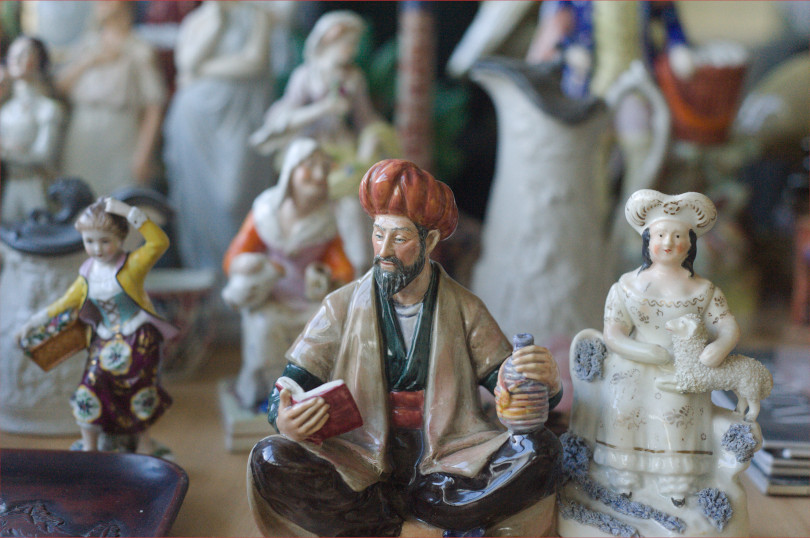
Staffordshire porcelain from the house of our friend the collector.